Case Lookup at Sedgwick County Courthouse lets anyone quickly find case number, filing date, party names, and assigned judge using the online portal. Whether you need a civil lawsuit docket, criminal charge details, or family court hearing timeline, the search returns case status, recent motions, and available court documents. Users often ask how to look up a case by name or by attorney, and the system delivers clear results within minutes.
Case Lookup also supports deeper research such as checking case history, viewing docket entries, and requesting certified copies of judgments. The database flags sealed or restricted records, explains why a case might be unavailable, and notes updates on pending versus closed status. By entering a docket number or party identifier, visitors can see filing details, hearing schedules, and outcome summaries, helping lawyers and the public stay informed.
How to Search Case Lookup
Case Lookup at the Sedgwick County Courthouse gives the public an online path to Sedgwick County court case records. A case online records can help identify the case number, filing date, party names, attorney of record, assigned judge, court division, docket activity, and status shown by the court. Use it to review a civil, criminal, family, or probate docket and to locate references to filings, motions, hearings, orders, judgments, and case outcomes. Each record and document has its own availability rules, and a sealed or restricted order can limit what appears online.
Official Search Portal: https://www.dc18.org/records
Steps to Search
- Open the official portal and select the public court case-record search.
- Enter the complete case number or docket number if it appears on a court notice, filing, or other paper.
- If you do not have a number, search by party name or attorney name, then add a filing date or case type filter when those fields appear.
- Review the result list and compare the case number, case title, filing date, court division, and party names before opening a record.
- Read the status, docket entries, and document links. Follow the portal instructions for paid records or certified copies when needed.
Court Case Search
A public court case lookup can begin with a case number, a party name, an attorney name, or a filing date. The most dependable search uses more than one identifier. A number can settle the match within the court system, while a name can help locate a case when the number is missing or copied incorrectly.
Search by Case Number
Use the number labeled as the case number or docket number on the court document. Copy the full identifier, including any prefix, suffix, or leading zeros shown on the original record. Court numbers often contain a component that identifies the case type or division, so removing part of the number can lead to no match.
If the portal shows several results for the same number, compare each result’s case title, filing date, court division, and party names. A wrong number often returns no result rather than a close match. If the number came from a handwritten note, check each digit against the source before changing the search.
Search by Party Name
Party name search works best with the full legal name shown on the court filing. Begin with a surname and given name, then add a middle name, suffix, or other naming detail when the result list contains several people. Searching one party at a time can reduce unrelated matches.
Name variations can make a valid case difficult to locate. A person may appear under a former name, a different suffix, or a spelling that differs from the name used by the person outside the case. Common surnames can also produce many results, so compare the filing date, case type, and court division before selecting a record.
Search by Attorney Name
Enter the attorney name shown on a pleading, hearing notice, or other court paper. An attorney search can lead to cases involving that attorney, but the result list may still require careful review because one attorney can appear in many unrelated matters.
The attorney shown in the case details represents the attorney of record at the time reflected by the docket. That person may not be the same attorney listed for every hearing or every phase of the case. Confirm the party, case number, and case title before relying on an attorney-based result.
Search by Filing Date
A filing date search can narrow a large result list, especially when a person remembers the year but not the case number. Use the date range and case-type filters shown on the search screen. Remove a date filter if the first search returns no match, since the remembered date may be a hearing date, order date, or document date rather than the filing date.
Each later docket item has its own date. The case filing date is normally the date tied to the opening case, while motions, orders, judgments, and hearing entries carry separate dates. Comparing the case number with the first filing date gives the clearest confirmation that the search landed on the intended record.
Compare Search Results
A case title is a short docket label and may not contain every legal name. Treat it as one matching point rather than the sole identifier. The strongest confirmation comes from matching the case number and filing date, then checking the party names, attorney, judge, and division against a court paper or prior case notice.
Some search results contain limited details because of record restrictions or because only part of the case has been posted. A restricted result can still confirm that a case exists. If the title appears similar but the number does not match, keep searching rather than treating the entry as the same case.
Case Record Details
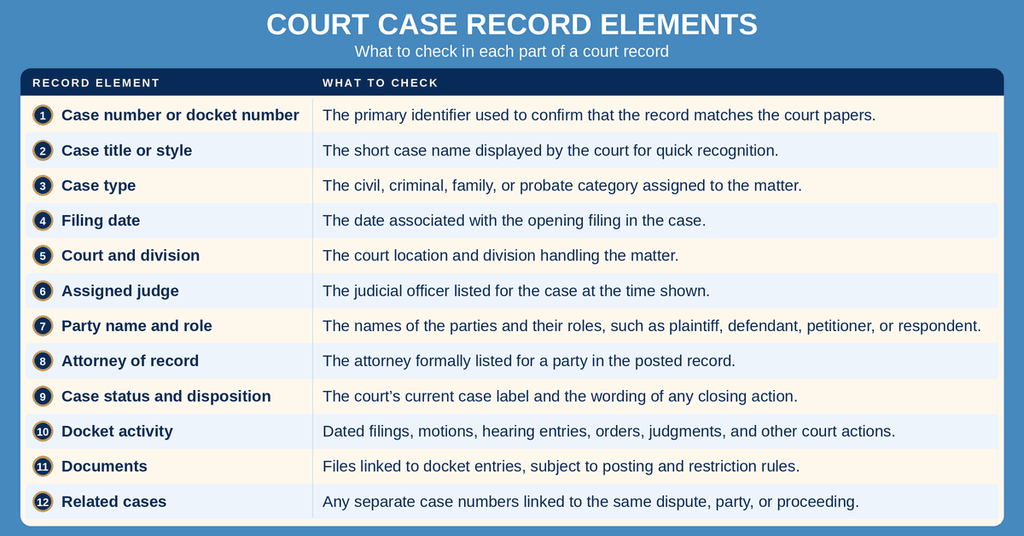
Opening a matched case produces the docket and the record fields currently posted by the court. The fields below help readers separate the facts that identify a case from the events that occurred after filing.
Read Party and Attorney Fields
A plaintiff starts a civil claim, and a defendant answers or responds to it. A petitioner asks the court for relief, while a respondent answers that request. Family and probate matters may use different labels because the legal issue and requested action differ. Read the full title and the docket entry instead of assuming that one label always applies to every case type.
The attorney of record is the attorney formally connected to the represented party in the docket. Representation can change during a case, so the attorney field may not match every attorney who took part in a hearing. For attorney searches, compare the listed attorney with the party and case number rather than relying on the name alone.
Read Judge and Division Fields
The court division shows where the matter was filed, and the assigned judge identifies the judicial officer listed in the record. These fields help distinguish cases with similar party names or titles. If a matter is later transferred or reassigned, a later docket entry or court order may show the change, so the current result page may not tell the full assignment history.
Read Status and Disposition Fields
Terms such as active, pending, and open normally mean that court activity remains in progress. Terms such as closed or disposed show that the court has marked the matter as concluded. A dismissal records a defined ending, while a resolution may use broader wording. An appeal entry shows that appellate activity has been tied to the case, and the related appellate record may carry a different case number.
Read the most recent disposition entry instead of relying on a short status label by itself. A closed case can still contain a judgment or order that explains how it ended. The label provides a quick status check, and the docket supplies the supporting detail.
Case Classifications and Docket Activity
The court case records system separates matters by case type and records later activity in a dated docket. Choosing the correct category helps narrow results before you compare party names or case numbers.
Filings, Motions, and Hearing Timelines
Docket entries place court activity in date order. A filing may add a new document, and a motion asks the court to take a requested action. Later entries can record a response, a hearing, an order, or another event tied to that request. The entry date shows when the court recorded the action, which may differ from the date on the underlying paper.
Hearing entries show a scheduled court event, not the result of that event. A later hearing date does not mean the earlier hearing produced a decision. To trace the hearing timeline, read the entries after the hearing date for an order, judgment, or new status. A scheduled date can also change, so a current docket entry carries more weight than a date printed on an older notice.
A newly filed case may receive a case number before every filing appears in the online docket. The same posting rule can affect later motions and orders. You can also consult case portal to locate official filings. This creates a short gap between a physical filing and the public docket view, making the case filing date an important matching field.
Orders, Judgments, and Case Outcomes
A court order records a direction or action taken by the court. A judgment records the court’s decision on a claim or issue. The case outcome, also called the disposition, shows how the matter ended. Depending on the docket wording, a case may close through a judgment, dismissal, or another recorded court action.
The status label alone may leave out important detail. Read the order or judgment linked to the docket to see the actual decision. If a case shows an appeal, check whether the docket supplies a linked appellate matter or an explanatory entry. An appeal can carry a separate case number outside the original trial-court record, so the trial docket and appellate docket must be reviewed as separate case histories.
Case activity can continue after the first judgment through post-judgment motions, collection activity, or other court actions. A closed label does not mean the court file contains no later entries. The full case history gives a better picture than one status date taken from a search-result summary.
Related Cases
One dispute may produce related matters with separate case numbers. A family dispute, protective-order request, or probate proceeding may involve a related court action with different parties or a different case number. Use any related-case link shown by the portal, then compare the party names, filing dates, and case titles before treating the records as connected.
Court Documents and Official Files
Court case records and court documents serve different purposes. The docket explains what happened, and a linked document may supply the underlying filing, order, or judgment. The following entries help readers distinguish the parts of a case file.
- Docket entry: A dated index line that describes a filing, hearing, motion, order, judgment, or other court action.
- Court filing: A paper or electronic submission added to the case file, such as a pleading, motion, or response.
- Court order: A court document that records a direction or action within the case.
- Judgment: A court document that records the decision on a claim or legal issue.
- Availability notation: A docket note that identifies a document or record as sealed, restricted, unavailable, or not posted.
Available Online Documents
A docket entry may include a link to an online file. Open the entry that matches the document you need, check its date and description, and then select the linked file. The description helps distinguish a motion from the order deciding that motion or from the judgment entered later.
Not every indexed docket entry has a downloadable file. A recent filing may have only its docket description, or an image may not yet be posted. An online file can also be removed from public view after a sealing order. These conditions explain why a visible docket entry and an unavailable document can appear within the same case.
A file viewed or printed through the portal serves as a reference copy. It does not carry the court’s certified-copy seal unless the court has expressly issued it as a certified copy.
Sealed and Restricted Records
A sealed record is closed to public view by a court order. A restricted record has limited public availability, and a confidential record is handled under an applicable legal restriction. The case may still appear in the search results, but the docket can omit sensitive filings, parties, or document images.
These restrictions can apply across several parts of a case file. A docket entry may remain visible while the linked document stays hidden. Some cases may show only a case number, basic case data, or a restriction notice. A missing document does not mean that the filing was never made.
If a case is known to exist but the portal shows no usable details, confirm the case number and filing date with courthouse records staff. Do not expect the public portal to reveal material covered by a sealing or restriction order. For a restricted document, ask about the official process for requesting a copy or viewing the file.
Requesting Certified Copies
A certified court copy is issued through the court’s certification process and carries the court’s authentication. A PDF file, printed docket, or ordinary downloaded image is useful for viewing, but it may not satisfy a request that calls for a certified copy.
When requesting a certified order, judgment, or other court document, identify the case number, document title, document date, and party names. Ask the courthouse records staff which request form, identification, fee, delivery method, and authorization rules apply. Do not assume that the portal fee or document fee is the same, and do not rely on a printed reference copy as proof of certification.
Keep the request confirmation and reference number with a copy of the submitted request. If the needed record is not visible online, a certified-copy request may still provide a way to obtain the official document. Record availability rules still apply to the requested file.
Record Accuracy and Resolution
A failed case record search can result from a mistyped number, a name variation, an incorrect date, a narrow filter, a recent posting delay, or a record restriction. Work through the details in a fixed order so each check tests a different part of the match.
- Confirm the complete case number, including its prefix, suffix, and leading zeros.
- Try the party’s full legal name, then remove middle names, initials, or punctuation and search again.
- Broaden or remove the filing-date range, and test a nearby date if the exact date is uncertain.
- Check the case-type and court-division filters for a misplaced selection.
- Search the attorney name and compare the result with the party and case title.
- Compare the filing date and case title against the court paper rather than relying on the name result alone.
- Review any notice that says a record is unavailable, restricted, or not yet posted.
- Contact courthouse records staff with the case number, party names, filing date, and document needed when the search still produces no match.
Recent Filing Update Delays
A newly filed case may not appear in the public search results at once. The court can create a case number and accept the first filing before the case reaches the online posting stage. Later motions, hearing entries, and orders can also take time to appear. The online case history is a posted court record, not a live view of every action as it occurs.
Do not treat a missing same-day result as proof that no case exists. Review the search once more after a posting interval, then check for an unavailable notice. If the case concerns an upcoming hearing or another time-sensitive event, contact courthouse records staff before relying on the online view alone.
Name Ambiguity and Number Errors
Common names and name variations create the most frequent source of crowded result lists. Compare the exact party role, case title, filing date, assigned judge, and attorney before opening a record. A result that matches the surname but conflicts with the year or case number is a different case.
A number error can occur when a prefix is missing or a digit is copied incorrectly. Prefixes often help separate matters by case type or division, and some portals require the full number shown on the filing. If the copied number returns no match, return to the original paper and compare each character.
Unlisted Case Resolution
An unlisted case may have been filed in another court, may still be outside the online posting cycle, or may be subject to a restriction that keeps its details from appearing. A party name may also differ from the name used on the court filing. Before contacting the courthouse, check the filing date, court division, case type, and full case number once more.
Give courthouse records staff enough detail to locate the official index entry. Include the case number, exact party names, filing date, case type, attorney name, and the document or status needed. Staff can explain whether the case belongs in the portal, whether an unposted document can be requested, or whether another court’s records office holds the matter.
If the purpose requires an official certified copy, state that need during the contact. Ask which document to request, how the request must be submitted, what fee applies, and how the copy will be delivered. These details can vary by record and request type, so the courthouse records staff should confirm them for the individual case.
Contact Information
Use the courthouse details below for a case that remains unlisted, a restricted record that needs review, or a request that the online case-record search does not handle.
Frequently Asked Questions
Find quick answers about using the Sedgwick County case lookup service, what data you can view, and how to solve common issues.
How can I start a case lookup in Sedgwick County?
Visit the official records portal at https://www.dc18.org/records. Choose the “Case Lookup” option, then enter the case number, party name, or attorney name in the search fields. Click Search to view matching records. If you need help, call the clerk’s office at (316) 660‑5900 during business hours. The system returns details such as filing date, court division, assigned judge, and docket activity.
What info appears in a court case record?
A case record shows the case number, filing date, case type, and court division. It lists party names, their roles, and the attorney of record. You also see the assigned judge, docket entries, motions, orders, judgments, and the current status—whether active, closed, or appealed. This snapshot helps track case history and upcoming events.
How do I find a case by the parties’ names?
In the case lookup portal, select the “Search by Name” option. Enter the full or partial name of a plaintiff, defendant, or attorney. The system matches any records that contain that name in the party or counsel fields. Review the result list to locate the correct case number, then click the number to view full details.
Where can I see the current status of a case?
After opening a case record, the status line near the top displays whether the case is active, pending, closed, or dismissed. The status updates whenever the court enters a new docket entry, such as a hearing, order, or judgment. For the latest information, refresh the page after any recent filing.
Why might a case not show up in the online search?
Some records are sealed, restricted, or not yet entered into the public database. Recent filings may take a few days to appear. Cases that were dismissed before official filing or those involving juvenile matters often remain unavailable online. If you cannot locate a record, contact the clerk’s office for verification.